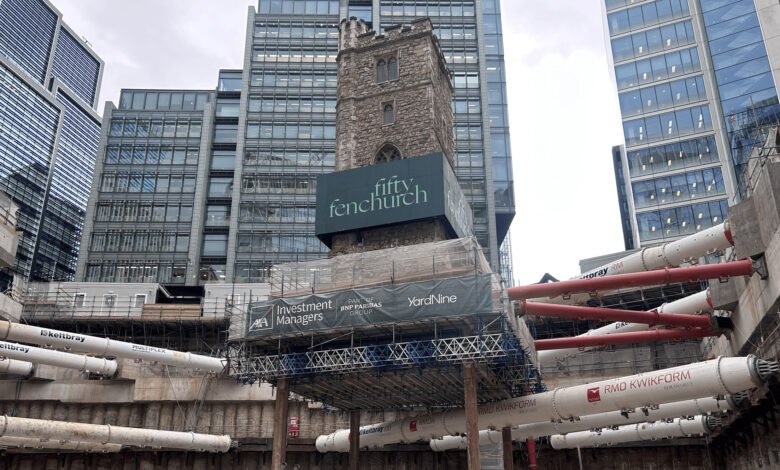
The redevelopment of 50 fenchurch street represents one of the most ambitious and technically complex construction projects currently underway in the City of London. Located within a dense historic environment, the site brings together modern commercial demands, deep-rooted heritage, and forward-thinking sustainability goals. This combination has placed the project firmly in the spotlight among architects, planners, and the wider development industry.

As London continues to adapt to evolving workplace needs, large-scale office developments must respond to both economic pressures and environmental responsibilities. The transformation taking place at this address reflects a broader shift in how central London buildings are designed, constructed, and integrated into their surroundings, ensuring long-term relevance in a rapidly changing urban landscape.
Location and Historical Importance of 50 Fenchurch Street
Situated in the heart of the City, 50 fenchurch street occupies a site with centuries of commercial and cultural significance. Fenchurch Street itself has been a vital route since Roman times, linking trade, finance, and civic life. The surrounding area includes historic landmarks, modern office buildings, and protected views, all of which have shaped the development approach.
The wider 46–50 Fenchurch Street site previously contained outdated commercial buildings that no longer met modern standards. Their removal marked the beginning of a new chapter for the location, one that seeks to balance economic growth with respect for the layered history beneath the ground and within the surrounding streetscape.
Vision and Scope of the 50 Fenchurch Street Development
The vision behind the 50 fenchurch street development is to deliver a world-class commercial building that supports London’s position as a global business hub. The project aims to provide high-quality office accommodation with flexible layouts, improved natural light, and enhanced amenities suited to contemporary working patterns.
Beyond commercial considerations, the development also focuses on public benefit. Improved pedestrian routes, active ground-level spaces, and a stronger relationship with neighbouring streets are central to the scheme. This approach ensures the building contributes positively to the daily experience of workers, residents, and visitors in the City.
Architectural Design by Eric Parry Architects

Eric Parry Architects were appointed to design the new building at 50 fenchurch street, bringing extensive experience in sensitive urban contexts. The architectural approach responds carefully to the surrounding environment, using form and proportion to reduce visual impact while still delivering a striking and confident presence within the skyline.
The building’s façade and massing have been shaped to respect nearby heritage assets and important sightlines. Rather than relying on dramatic gestures, the design focuses on refinement, material quality, and longevity. This architectural restraint helps the building integrate seamlessly into its historic setting while remaining distinctly modern.
Planning Process and Regulatory Considerations
Securing planning approval for 50 fenchurch street required extensive consultation and assessment. The City of London planning authority carefully reviewed the proposal’s impact on heritage assets, protected views, transport infrastructure, and public realm. Each aspect of the scheme was tested against strict planning policies.
Engagement with stakeholders, including conservation groups and local organisations, played a key role in shaping the final design. Adjustments were made throughout the process to address concerns and ensure the development delivered wider benefits, demonstrating the importance of collaboration in complex urban projects.
Heritage Preservation and the All Hallows Staining Church
One of the defining features of the 50 fenchurch street project is the preservation of the Grade I listed All Hallows Staining church tower. This historic structure stands as a rare survivor of medieval London and required exceptional care during redevelopment works taking place around and beneath it.
Innovative engineering solutions were developed to temporarily support the tower while deep excavation occurred below. This delicate operation highlights how modern construction techniques can coexist with heritage conservation, allowing historic structures to remain protected while enabling significant urban development.
Archaeology and Discoveries Beneath 50 Fenchurch Street
Archaeological investigations at 50 fenchurch street revealed layers of history spanning Roman, medieval, and post-medieval periods. These findings offered valuable insight into the evolution of the City and required careful documentation before construction could proceed.
The presence of archaeology influenced construction sequencing and design decisions, ensuring remains were recorded responsibly. This process reinforces the importance of archaeology in major London developments, where each site contributes new knowledge about the city’s long and complex past.
Construction Strategy and Role of Multiplex
Construction of 50 fenchurch street is being led by Multiplex, a contractor known for delivering complex, large-scale projects. The constrained site conditions, combined with deep basement requirements and heritage protection, have made construction particularly challenging.
Advanced engineering methods, detailed logistics planning, and close coordination between teams have been essential to progress. The project showcases how innovation and experience are critical when delivering high-profile developments in dense urban environments like the City of London.
Sustainability and Environmental Performance
Sustainability is a core principle of the 50 fenchurch street project. The building is designed to operate as an all-electric development, reducing reliance on fossil fuels and supporting London’s long-term carbon reduction goals.
Attention has also been given to embodied carbon, material selection, and energy efficiency. By prioritising sustainable design from the outset, the development aims to meet both current and future environmental standards, ensuring resilience and long-term operational efficiency.
Future Impact of 50 Fenchurch Street on London
Upon completion, 50 fenchurch street will play a significant role in shaping the future of the City’s commercial landscape. The building will provide modern office space suited to evolving business needs while contributing to a more sustainable and inclusive urban environment.
Its completion will also demonstrate how ambitious development can coexist with historic preservation. The project stands as an example of how London continues to reinvent itself, blending innovation with respect for its past and setting a benchmark for future city-centre developments.
Conclusion
The redevelopment of 50 fenchurch street is more than a commercial construction project; it is a statement about how London builds for the future. Through thoughtful design, careful planning, and advanced engineering, the development balances heritage, sustainability, and economic ambition.
As the project moves towards completion, it continues to attract interest from across the property and construction sectors. Ultimately, the building will serve as a lasting contribution to the City, reflecting London’s ability to evolve while preserving the character that defines it.